
If you’re a part of a huge company, you should be getting coverage from major, top-tier publishers and mass media. If you’re in a small or medium-sized business, you should be focused on earning coverage from topically authoritative niche publications. If you do get Tier 1 coverage, there’s definitely still clear value from a traditional SEO and PR perspective. However, smaller and mid-sized brands will get more visibility appearing in front of a more curated audience instead of being hidden behind a paywall or getting buried by the natural news cycle.
In this guide we’ll explain the following AI PR best practices:
Where are Audiences Actually Consuming their News in 2026?
At this point, it would be old news to say that audiences are cutting cords and canceling newspaper subscriptions for online sources of their daily information. The real story is becoming less about people being online and more about where they’re going online to consume their news and trending topics. Taken a step even further, we’re closely monitoring the way that people are increasingly relying on different AI interfaces to aggregate their news and information.
In a prior blog, I explored the essential role that public relations tactics play in AI visibility for a zero click search environment. But before you start blindly pitching media with the hope of impacting your brand’s AI search results, you need to understand some basics about the current state of journalism in the U.S: and how AI engines are digesting news sources for their end users.
Are audiences really getting their news from AI? Well, that might be too simple of a question.
Traditional audiences who consume the news from front to back cover are aging out. Younger Millennial and especially Gen Z audiences aren’t flocking to the same major media outlets for their news, even as they become decision makers in their careers. It’s far more likely that they’ll either use search engines or algorithmic social media feeds to discover and learn more about the trending topics that matter to them. While only a select few people are currently using AI chatbots for their news, more widely utilized search engines and social media platforms are increasingly adopting and creating their own AI search functionalities. Some examples include Google’s AI search box, and Meta AI.
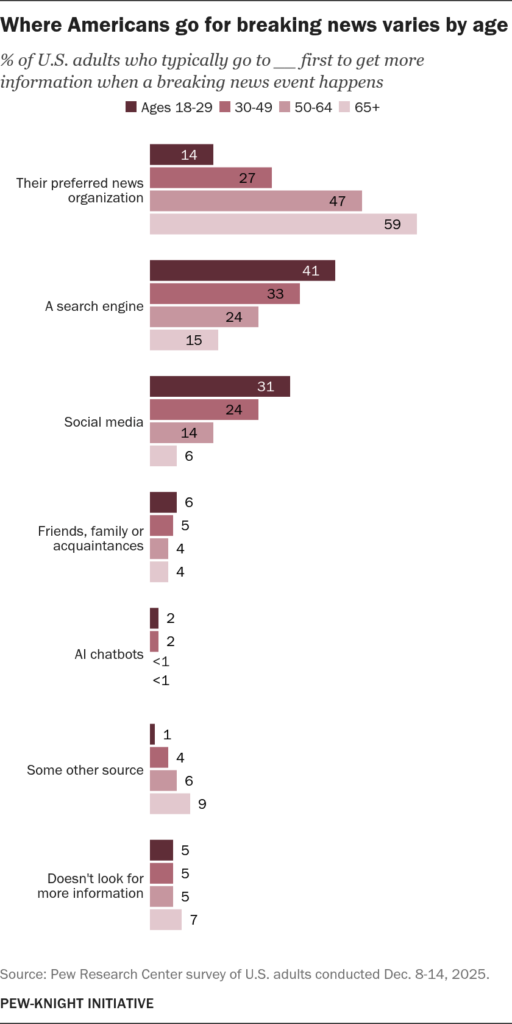
Even though AI is only taking a small chunk out of direct news consumption, it’s upending how people online search for and interface with information more broadly—marking both challenges and opportunities for brands seeking media exposure. For example, Perplexity, a self-proclaimed AI “Answers Engine” that curates sources, including news, reports and community forum discussions, based on specific user prompts (much like an evolved search engine), reported more than 780 million queries per month last summer. As recently as March 2026, 48% of traditional Google searches include AI overviews that curate sources into natural language overviews, similar to something like Perplexity. Even for audiences not directly turning to AI for their news, the way they seek out and consume information is unmistakably impacted by the blossoming of AI experiences. With all of that said, news coverage, in particular news from targeted outlets, plays a significant role in the information that AI models are prioritizing within their increasingly personalized search interfaces.
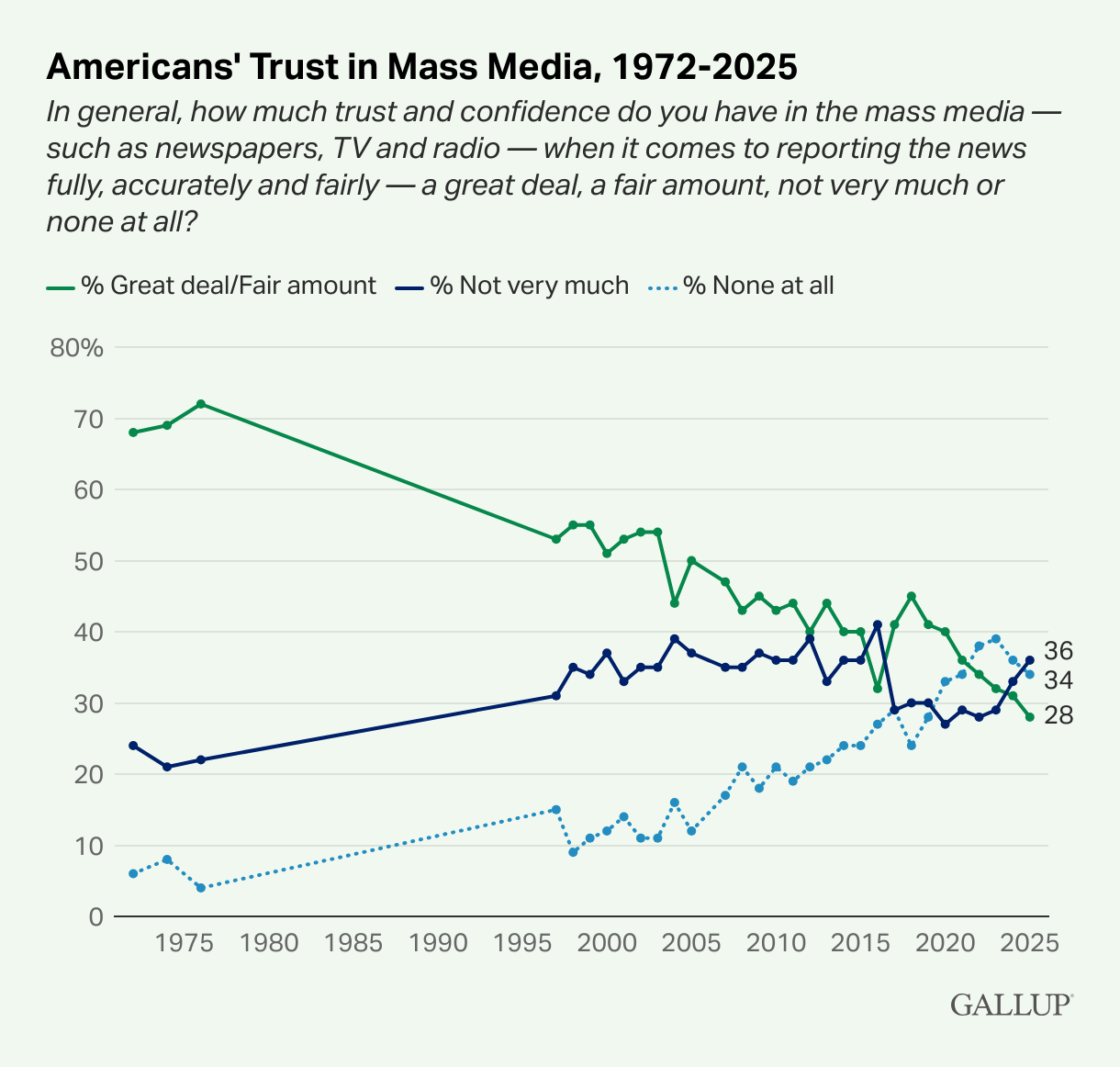
Compounding that shift, trust in the mass media has eroded for many Americans. People are increasingly concerned that the information being presented may reflect a publication’s preferred narrative more than a trustworthy, neutral point of view, a trust gap that typically magnifies with the scale of news entity in mind.
So, why does this matter for the future of PR?
Based on declining readership, weakening public trust and the rise of algorithmically AI-integrated search results, a brand mention or feature in a major publication alone has fluctuating impact. While brand awareness amongst tier 1 outlets is positive, the way that AI engines are meeting their users’ appetites for more trusted sources of information means that high-profile hits are not always giving companies the same lasting impact in GEO terms as more trusted and targeted trade outlets.
Today’s PR programs are benefiting from hyper tailored strategies that bring visibility in focused trades as opposed to exclusively chasing mentions in the biggest publications.
Pitching the Right Publications:
In the past, PR pros have prioritized earning coverage in publications with high UVM (Unique Visitors per Month), or AVE (advertising value equivalent). The logic is simple, more eyeballs mean more potential to be seen by the right audiences. We’ll lean on the Wall Street Journal to illustrate the shifting value on traditional news coverage for brands throughout this piece. According to SEMrush, a leading digital market data platform, WSJ has an estimated UVM of 22 million. That’s a lot of people, but it’s unclear how many of those users are going to actually read your article.
What if your article is blocked behind a paywall and is only accessible to WSJ subscribers; how many people will read your article then? What if your article is a thought leadership piece with a long-winded title about a topic that nobody really cares about? If you’re not covering an interesting or important topic, it’s just going to get buried within the 500–600 stories that the WSJ posts every day. Consequently, that makes it just another generic reference point that AI models are less inclined to bring into conversation with specific prompts.
You get the point: UVM and AVE are becoming vanity metrics in an AI visibility environment. While the logic of gaining more attention for audiences scanning headlines holds up, the rise of curated AI search behaviors mean that PR professionals have to factor in fewer readers scanning for headlines directly and instead factor in AI models that automate the scanning process to curate personalized news sources for the particular discovery each user is carrying out.
With increasing consideration for news coverage’s relationship within AI response, we’re recommending two different approaches based on client size and audience characteristics that promote optimal AI discovery for different kinds of brands.
AI PR For Small and Medium-Sized Businesses: Focus on Niche and Trade Publications with Specific Topical Authority
For our smaller to mid-sized clients, we’re focusing on pitching targeted and niche trade publications, blogs, podcasts, YouTube channels, and newsletters with more relevant audiences and keyword rankings that are related to what the client does–and how audiences are using AI to find them. Larger pubs output a massive amount of information about a variety of different organizations and companies. They also try to block AI crawlers from reading their content due to licensing disagreements between mass media and AI companies (somewhat ineffectively, I may add). We don’t want our clients’ presence on these sites hidden behind paywalls; we want them on pages that are available to AI and contextually related to the services and solutions they provide.
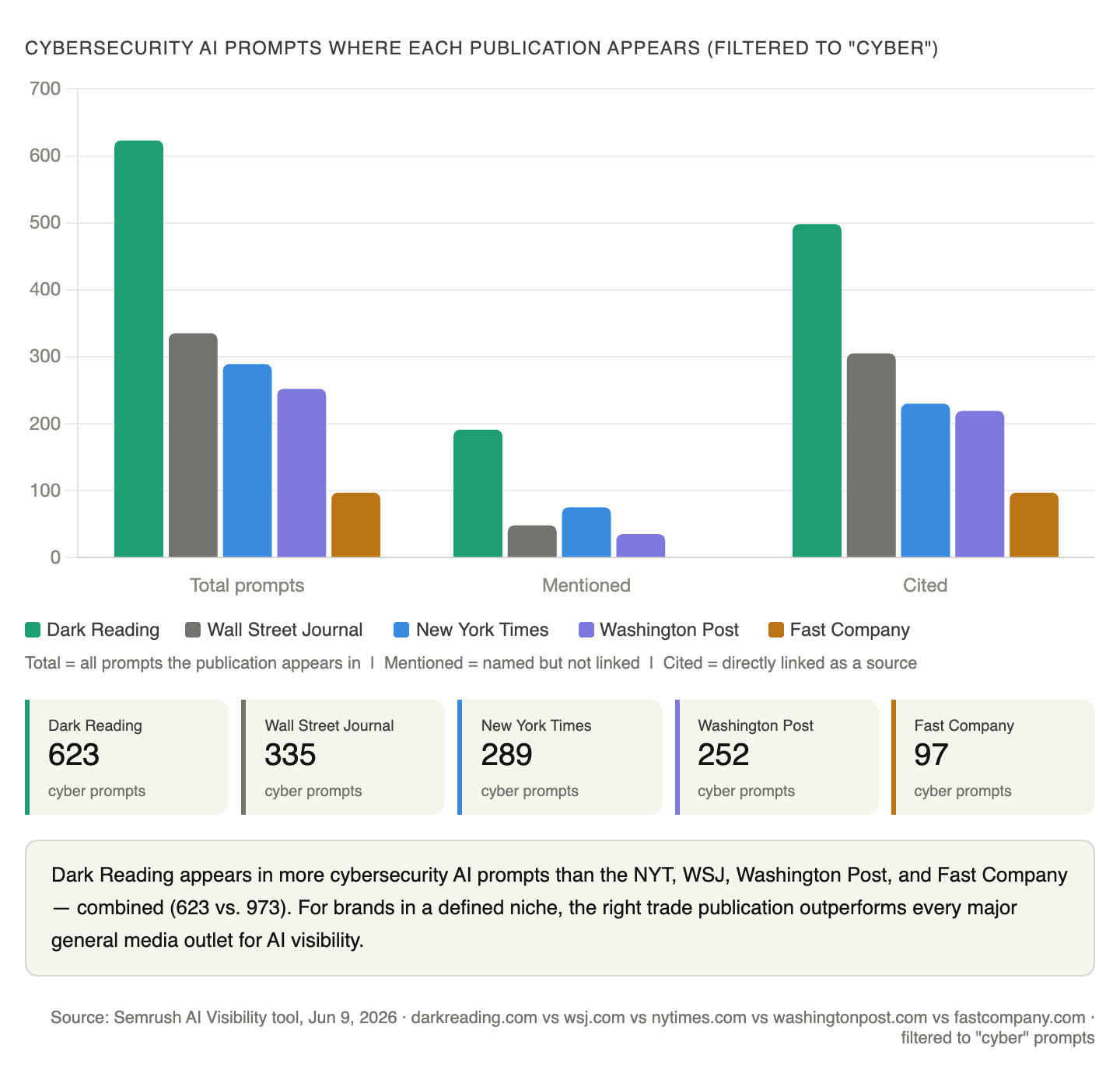
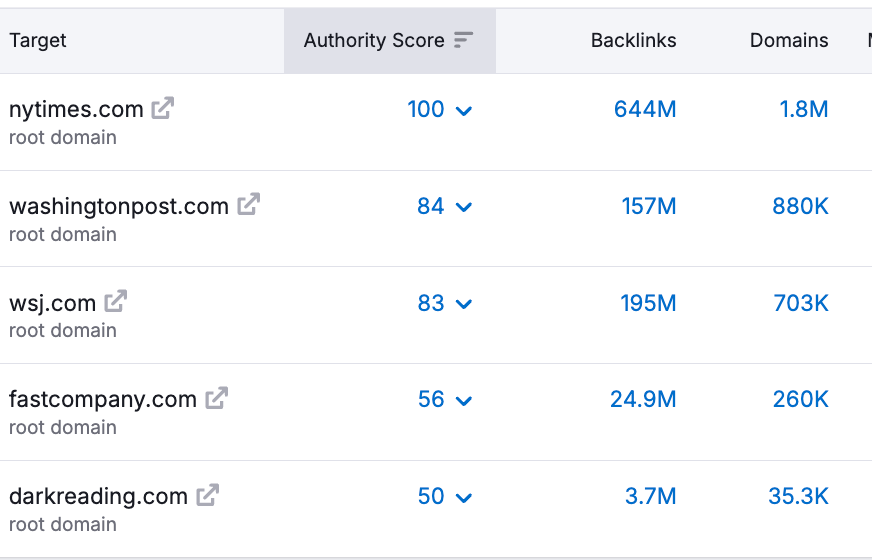
Let’s take cybersecurity as our industry example. Let’s say you are a mid-size cybersecurity business with a tightly defined market offering and competitive advantage in specific areas of the market and you just hired Matter as your new PR firm to be more visible to your decision makers. Your audience, IT decision makers, are likely turning to AI with niche industry vocabulary in their prompts. They’re not exploring topics from the high-level and digging deeper. They’re jumping right into a deeper level of discovery than non-technical audiences. Again turning to SEMrush, we examined how major publications stacked up against a much smaller, but more niche cyber trade publication (Dark Reading) when prompting for cybersecurity related topics. We found that this specific trade publication is cited in 2.6x more for AI prompts that include the word “cybersecurity” than the listed Tier 1 outlets. They were also able to accomplish that with a much smaller domain authority:
How is “Domain Authority” or “Authority Score” determined?
A number on a scale of 0-100 (100 being the most authoritative) that represents the quantity and quality of the links that point to a domain, and estimated organic traffic based on the number of keyword rankings and avg. ranking position.
Based on our experience, if you’re a small or medium-sized cybersecurity business, we recommend focusing primarily on gaining more visibility in publications that have more direct AI authority in your desired narrative domain (e.g. “cybersecurity”).
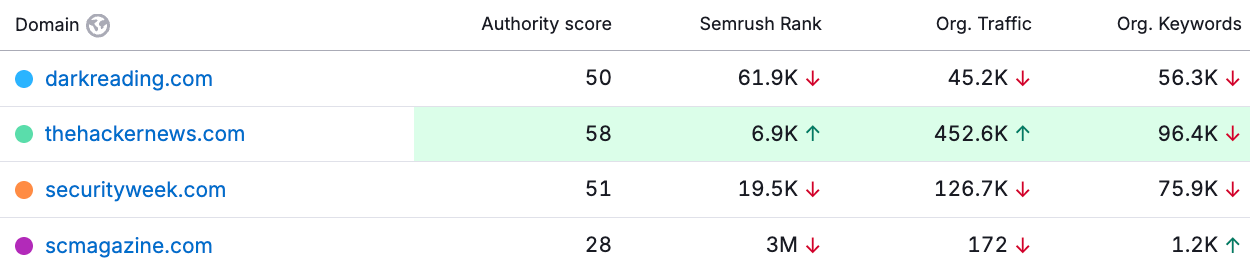
So, it’s clear that trade publications outrank broad publications on specific subjects but what if we compare Dark Reading to other peer cyber pubs for relative AI visibility? We found that The Hacker News is the best, most authoritative publication for this space, which isn’t surprising considering they also define themselves as a “top cybersecurity news platform”:
AI PR For Large Enterprises: Focus on Major Media; Trade Mentions Will Happen Organically and Via Syndication
Now, let’s say you’re a large brand with a highly diversified offering. Those highly valued trades are likely already reporting on every bit of news you announce. For larger enterprises, PR teams should always target coverage in publications with an authority score that matches or exceeds your organization’s. For example, Cloudflare has thousands of employees who work on a wide variety of business lines. While also in the cybersecurity space, their services are not niche so their coverage shouldn’t be either:

For Cloudflare, a business that likely caters to less niche enterprise decision makers than a mid-size cybersecurity vendor, a mention from WSJ comes with high authority for less technical prompts that AI engines are likely to match with broad-interest sources, like WSJ, that can reinforce the company’s credibility, and relevance across a much wider set of business and technology conversations that their target decision makers are interacting with.
Enterprise communications teams should focus less on maximizing topical relevance and more on maximizing authority alignment. When a brand operates across numerous markets and product categories, AI systems are more likely to associate it with broad-interest, highly authoritative publications that can validate the company across a wider set of business and technology-related queries.
Key Takeaways
The rise of AI-powered search isn’t changing the value of earned media but it is changing how PR teams should think about maximizing the value of coverage. The publications that influence AI responses are not always the ones with the largest audiences. Instead, brands should align their media strategy with how their audiences search using AI: niche businesses should prioritize topical authority, while enterprise brands should prioritize authority at scale. As AI becomes a larger gatekeeper of information discovery, the winners will be organizations that build credibility in the publications AI trusts most for their specific narrative domains.
1. Stop measuring success solely by reach: In an AI-driven search environment, the publications that influence the responses you want to appear in are not always the ones with the largest audiences.
2. Match your media strategy to your company’s size and audience: Smaller brands typically benefit most from topically authoritative trade coverage, while enterprise brands gain more value from broad, high-authority media outlets.
3. Quality of placement matters more than quantity of placements: A handful of strategically targeted media hits can create stronger AI visibility than a large volume of less relevant coverage.