• Marketing Mojo: Wisdom from Nerdio Chief Revenue Officer Joseph Landes

    Erin Brooks, marketing & communications specialist at Matter, recently spoke with Nerdio’s Chief Revenue Officer, Joseph Landes, to discuss his transition from 23 years at Microsoft to the startup world. Brooks and Landes explore the role of the CRO, trends in marketing, best practice and more. Check out the video from the interview and read the full conversation below.


    Erin Brooks (EB): Joseph, tell us a little about yourself and Nerdio.

    Joseph Landes (JL): First and foremost, I’m a father, a son and a husband. I joined Nerdio about five months ago after working at Microsoft for 23 years and I’m the Chief Revenue Officer leading sales and marketing. Nerdio is an IT automation platform and our entire mission is about empowering managed service providers (MSPs) to build successful cloud practices in Microsoft Azure.


    EB: What is it like going from a big role and company like Microsoft to an aggressively growing startup like Nerdio?

    JL: First of all, let me say Nerdio is an unbelievable company. Moving from a big company like Microsoft to an incredible startup like Nerdio was scary at first but has proven to be quite fulfilling. When you’re at one company for 23 years, you not only learn a lot, but you get used to a certain way of doing things. You ask yourself, “am I going to be able to take all of this learning and apply it to a completely different scenario? To a completely different company?” As my former CEO, Satya Nadella, says, you always want to be a learn-it-all person rather than a know-it-all-person. Since arriving at Nerdio, I’ve committed to becoming a learn-it-all person: To spend time with as many partners as I can, ask questions, learn about the ecosystem and talk with my team about what we could be doing better.

    Certainly, any time you move from a company like Microsoft to a company like Nerdio, there’s just going to be different ways of doing things. But one of the things I love about Nerdio is we move fast – we’re an exciting place to work, and everybody’s empowered to do amazing work every day on behalf of our partners. We have a tremendous founder and CEO, Vadim Vladimirskiy, who bleeds Azure every day, and we’re all doing the best we can to empower MSPs to build successful practices in Azure.


    EB: Why is integrating sales and marketing important? How does this help the sales teams?

    JL: In the old days, sales would always complain about marketing, saying marketing’s not bringing enough leads. Marketing would complain and say sales isn’t doing much with the leads. In my role, as the CRO overseeing both sales and marketing, there’s no room for that. Everything we do is coordinated between sales and marketing as one team with one mission to help MSPs be successful. The attributes of a good marketing team, and quite frankly, any team, is togetherness. A team has to come in every day, and feel as if they’re together headed towards one common mission. We have a set of very talented marketers at Nerdio, supplemented by a set of very talented folks like Matter, and others that we work with which helps us be number one in our space and provide the best service possible to our MSP partners.


    EB: On that note, how have you seen the CRO role change over the last few years? How does this position, being in charge of both sales and marketing – and ultimately responsible for the voice of the customer – impact the bottom line?

    JL: Only within the past couple of years has there been this role called CRO, where organizations combine sales and marketing into one. That’s been the evolution of the CRO, having one person who’s accountable for not just driving the numbers every day when it comes to new customers, units and revenue, but really thinking through how the marketing is going to be the fuel for that engine. The goal as chief revenue officer, and as a company like Nerdio, is to look not just at what’s going on in the cloud space and figure out who’s doing great things that you can emulate, but to look outside your space and see where can you be inspired with great ideas.


    EB: What marketing initiatives at Nerdio will you invest more heavily in over the next year? What will become less of a priority and why?

    JL: One of the big initiatives that we’re moving forward with is a robust content marketing strategy to make sure that every MSP has what they need to implement Microsoft Azure and build a robust cloud practice. Another area that’s incredibly important to us at Nerdio is going to where the MSPs are, such as events and conferences. Finally, you’ll see us much more active in our digital and social strategy, as we know MSPs get their information through those channels.


    EB: Are there any companies or marketers you admire, in terms of their approach and/or marketing strategies?

    JL:  The best marketer I have ever had the opportunity to work with was a former manager of mine, Bob Vicee, who’s sitting somewhere in Eastern Washington on a ranch. Bob, if you’re read this, I hope you’re enjoying what it is you’re doing. Bob was the first marketer that encouraged me and my team to go to the edge of the cliff – where you feel like you’re about to fall off, but you don’t. That’s where I believe the best marketing happens. Great marketing happens when you’re willing to take risks, and try things that others have not tried, as opposed to just continuing to use the cookie cutter. Bob was an advocate for me personally, encouraging me to take risks and break the mold.


    EB: Speaking of risks. What has been one of the biggest marketing risks you’ve taken either in your career or at Nerdio? How did it play out? And, what did you learn from it?

    JL: One of the biggest marketing risks I took in my career was at Microsoft India. Our goal was  to get local developers in India to build more apps for our Windows platform. We ended up renting out a big cricket stadium in India, called the Guinness Book of World Records in the UK, and made it our mission to set a record for the number of developers coding for 24 hours straight under one roof. I had no idea if that was going to work. Within 24 hours of promoting the event, we had about 2500 developers wanting to participate. It was certainly a big risk – I didn’t know if it was going to work at all. But it turned out to have huge reward at the end, because it was something that nobody else had done in India, or in the ecosystem, and it garnered us a lot of respect in the industry for trying something new.


    EB: Wow, that’s amazing. Have you encountered risk like that at Nerdio?

    JL: I’ve only been at Nerdio for five months, and I can’t honestly say that we’ve taken enough risks in the time that I’ve been there. Becoming much more precise around our target audience was not a risk, more like stating the obvious. We can be number one in that category, and stating it out-loud drove a lot of clarity in the company around what we do best within the industry.


    EB: How do you leverage a big name like Microsoft in your own marketing strategy?

    JL: Microsoft is an incredible partner of ours. It’s very different to be outside of Microsoft than inside Microsoft. When you’re outside, and you’re looking in, you realize that it is a tremendous company with a tremendous set of resources. You find that that if you’re smart and if you know how to leverage it, you can really benefit your company. Our mission aligns perfectly with what Microsoft wants to do, which is to get more and more customers onto Azure. This is something that we can help Microsoft do, particularly with small and midsize customers who rely on MSPs for guidance and for help on implementing their solution.


    EB: What KPIs are most critical to your executive team and board? How are you measuring the effectiveness of your marketing and PR programs?

    JL: The KPI that is most important is to be number one in the Azure space. We believe we’re uniquely positioned in the market to have a solution for MSPs that allows them to provision, price, manage and optimize an Azure environment in a way that nobody else in the market has today. Between marketing and PR, there are many things that we’re going to do to ensure that the world knows that we have this unique offering. You’re going to see us drive that fact very hard as we move forward, whether it’s PR metrics, social metrics, digital or the number of partners we work with. At the end of the day, we want our client MSPs to be successful and happily working with Nerdio.


    EB: Why is PR an important part of your marketing strategy? What are some of the benefits of working with an agency like Matter?

    JL: You can never do too much PR, and I’m someone that would love to be in front of people talking about what Nerdio has to offer MSPs every single day. When you work with an agency like Matter, you gain a certain amount of structure to your PR efforts. You know who you are going to be speaking with and that these people are influential. PR is an indispensable tool for any marketer, and quite frankly, for any company like Nerdio. Having an agency that partners with us like Matter is a blessing .


  • 3 Keys to a Successful Video Review Process

    3 Keys to a Successful Video Review Process

    The review or feedback phase of a video project can be the longest and most ill-defined aspect of the video creation process. When your project team and the video marketing agency you’re collaborating with aren’t on the same page, your video can stumble before it’s even out of the gates. After 7+ years and over 500 review cycles under our belt, we’ve identified a few best practices that will make for more productive and rapid review cycles for everyone. Who couldn’t get behind that? Here are a few tips to help you facilitate a smooth and successful video review process.

    1: Editors Love Consolidated Feedback

    Consolidated feedback…

    Comes from one person — generally the person championing the project. This person solicits feedback from all other stakeholders (colleagues, executives, customers, third parties) and filters it to mitigate conflicting and ambiguous feedback. Progress can come to a halt when an editor can’t make heads or tails of whether to prioritize Katy’s feedback or Tom’s. The fewer cooks in the kitchen the better the broth, so always designate a head chef.

    Incorporates feedback into as few emails as possible. Numerous emails in endless threads only makes it more difficult for your video editor to see and execute all requests in a timely fashion. Projects are sometimes passed back and forth depending on an editor’s workload, so it’s ideal to collect all feedback in a single email at the end of the day or week when possible. Be sure to also let your editor know if all feedback is “in” for a version or if there’s more to come, as this helps maintain version control of the video.

    2: Viewing Tips for Crafting Constructive Feedback

    Watch Attentively. Focusing on different elements with each repeat viewing will maximize the effectiveness of the early rounds of feedback. This is important as most video agencies allow for two or three rounds of revisions at most, but when leveraged properly, that’s more than enough. First watch for the messaging, then the visual and graphic elements, and finally the overall tone/mood:

    • Messaging – does the story and flow make sense? Does it deliver the key messages succinctly? Does it leave the viewer a clear understanding of the takeaway(s)?
    • Shots – Do the visuals reasonably match what’s being said? Is there anything being shown that shouldn’t (e.g., sensitive information)?
    • Graphics – do all textual GFX elements (intro/outro, lower thirds, etc.) contain your preferred final copy, and are they spelled correctly? More importantly, is the overall look and feel on-brand?
    • Tone/mood – How does the video and choice of music make the viewer feel? Is it appropriate given the goals of the project?

    Watch and listen through the lens of your audience. For instance, the music may not match your personal taste, but does it align with the tone and mood of the video? Chances are it does, as video editors work with emotion in mind when crafting the story — and the music bed helps amplify that. 

    3: Include Important Stakeholders Early On

    If final approval of the video will run through someone other than or in addition to yourself, involve him/her/them as early in the process as you’re comfortable with. We can relate to the desire to only show the higher-ups something you consider 99% finished, but they may have their own (very different) set of assumptions about what the video should accomplish. That needs to be heard as early as possible. Video marketing agencies carefully monitor and manage their team’s workload by project phase, so significant last minute rework can throw a wrench in things and possibly delay your final project. So consider sharing the polished V1 with anyone else whose opinion on the project will be significant, and/or have a thorough discussion with them during the ever-important pre-production/strategy phase.

    Cultivating your ability to give clear, constructive feedback will go a long way towards building a strong relationship with your video vendor. And, will help keep your projects on time and under budget, with final pieces that exceed expectations. 

    Ready to work with our award-winning creative team? Fill out the form below to schedule a free strategy call.

  • Your Questions About Drone Videography Answered

    It’s 2019, and drone videography isn’t the “next big thing” anymore- it’s certainly here to stay. With that said, everyone wants aerial views of their business or property but without the added stress of figuring out how to fly a drone without crashing. Is it possible to achieve these results without breaking your marketing budget? The answer is yes. Ever since the inception of FAA Part 107 (better known as the 2016 commercial drone regulations), we’ve captured companies and employees alike from a bird’s eye view for a wide array of uses. As long as your office resides outside of the 5 statue mile radius (or ‘No Fly Zone’) from a major airport, we can help you get that aerial video footage. And if you are within this range, helicopter tours are certainly an option.

    Before diving in, it needs to be mentioned that we cannot predict the weather. While the drone will work in cold temperatures and winds up to 20 MPH, it’s certainly not going to make your location look its best. In New England, we’ve noticed clients want their properties filmed during the late summer/early fall, when the foliage is at its peak. We’d recommend you take shots during a preferred time of year, and then keep the assets in your back pocket.

    Now that mother nature has been spoken for, here are three ways to utilize drone photo/video capabilities.

    Establishing Shots 

    In almost any marketing or company video, the first few seconds establish where we are. Unless the setting is downtown in a major metropolitan area, this shot is usually an exterior of a building. It is much more energizing to see a flyover of a building, farm, or shop than the basic low angle “tilt down” move that many videographers are guilty of taking. A flyover of a college campus on a spring day says a lot more about the school than a shot of the sign and logo out front.

    Construction/Renovation Processes 

    Something that’s just as amazing to the eye as the shiny new addition to your company’s campus, is the process it took to get there. Drone technology is getting to the point now where you can create a pre-determined path, and fly it multiple times. These flights can happen days, weeks, or months apart and distinctly capture the same flight path over and over. How cool would it be to see an aerial orbit of the construction process that showcases all phases in just a single loop? Now you can.

    Tracking Text, Stats, or Subjects

    Depending on your audience, white pages of percentages and stats are an easy way for people to tune out. Instead, try recording some smooth flyover shots where you can employ motion graphics and animation to track titles, statistics, or any other on-screen graphic. Anything above the horizon line is a blank canvas for larger amounts of text, and anything below is good for icons and shapes. This technique also works well if you’re flying directly over your subject, with the camera pointing straight down. A street, field, or body of water is typically homogenous enough to use for these things. Each environment has its own unique advantages and disadvantages, so use your best judgement.

    Finally, like anything else, drone shots are great in moderation. Part of what makes them look so unique is that they’re juxtaposed with closer shots, and the contrast is what the audience likes to see. Use them, but don’t abuse them.

    Ready to work with our award-winning creative team?

    Fill out the form below to schedule a free strategy call with our team.


  • Best Practices for Conducting Professional Video Interviews

    Best Practices for Conducting Professional Video Interviews

    In today’s visual and digital world, a video interview is a key strategy used by companies to get their messages across to their audience. These interviews are used on homepages, landing pages, social media pages, and often played at large scale meetings or events. However, to be most effective in reaching and engaging a target audience, these video interviews need to tell compelling stories. Here are some of our favorite tips to help you get from the research phase to the filming stage as smooth as possible, and conduct a conversation that results in captivating interview content.


    Tips for Question Development

    The first part of the interview process is to develop the questions. You should never walk into an interview unprepared and you need to be ready for anything that can come your way. Follow these tips when working on question development:

    1. Thoroughly research your subjects. Find out as much as you can about your subject(s) from Google and LinkedIn, so you can demonstrate you’ve done your homework and develop rapport more easily and quickly on-site. 
    2. Order matters. Begin the interview with “softball” questions and questions about the subject can answer about themselves to warm them up. You don’t want to jump right in with the hardball questions.
    3. Keep the story front and center when creating your interview questions. Allow for the spontaneity that produces unexpected gold while making sure you get the storytelling scaffolding you’ll need to bridge everything together. You should either be setting your subject up to tell an interesting, emotional story with your question, or setting them up for a clear and succinct answer you know the answer to in advance.
    4. Ask questions that begin with “Tell me about…,” and “Paint a picture of…” Use words like how, why, where and what to avoid simple answers and to get the subject speaking in story.
    5. Don’t neglect the problem of the story. You don’t have a story if you don’t have conflict, so make sure you’re asking plenty of questions like, “What was the frustration with the old way?” or “What were these issues costing you?” Sometimes people are reticent to go into this, as they don’t want to seem incapable, so phrase those questions delicately.
    6. The shorter and simpler your interview questions are, the better. Instead of asking long winded questions, ask follow up questions such as: “What do you mean by that?” “What did you learn from that?” “Why is that important?” “Why?”…  “Why?” … “Why?” (until you get to the underlying point).
    7. Your questions are not an instruction manual. You shouldn’t hesitate to drop them (at least temporarily) to go off-script.
    8. Your demeanor/attitude is just as important as your questions. If you’re not invested, energetic, personable and courteous you shouldn’t expect your interviewee to be either. Even if you’re not in the best mood, you can’t let it affect your interviewing. As the interviewer, you’re more of a coach and cheerleader than anything else. Help them find a relaxed comfort, or even a sense of pleasure, in talking to you.
    9. Always close by asking if they have anything to add that you didn’t ask about. Often some of the best material comes from these open-ended moments.

    Tips for the Pre-Interview Spiel

    As you and your interviewee settle in and the crew is finalizing camera positioning and lighting, we like to deliver a short “pre-interview spiel” that goes over critical context and background to help ensure a smooth and productive conversation. At Matter, we keep it very conversational ensure the talent is relaxed and excited. Here are a few points we find it helpful to include: 

    1. Tell the talent to look directly at you throughout the interview, never at the cameras. Consistent eye contact is one of the best ways to come across as confident in the final video. 
    2. Explain how the interviewer’s voice will not be heard in the final video so the talent will need to provide context when answering a question. 
    3. Assure the talent not to worry about any mistakes and that the video will be edited with the goal to make them appear as credible and confident as possible. 
    4. Encourage the talent to be energetic as it translates positively on camera. What can feel a bit silly or exaggerated in person often feels appropriate for the heightened reality of the final video. 
    5. Ask if there are any questions or clarification needed before beginning, and always provide them with a glass of water to avoid dry mouth.

    Tips for Common Interview Challenges

    Even if you are well prepared, the interviewee is prepped, and the cameras are rolling, things can still go wrong along the way. Here are a few tips on dealing with common interview challenges:

    1. If they’re psyching themselves out or getting nervous remind them to relax and tell them they’re doing great. 
    2. If they’re not giving you enough energy to be compelling, try to kindly cajole them out of their shell a bit. If you are excited and interested, then they will be as well.
    3. If they’re rambling, ask if they could be more succinct. This can help them reframe how they approach their answers and is usually an easy ask. 
    4. If they’re speaking too formally and not to the intended audience, ask them to imagine you as whomever is relevant (a prospective client or employee, for example) and use words like “you” and “yourself” rather than “they” and “them.” This is more compelling because it engages the audience more directly. 
    5. If you know the interviewee flubbed on an important point, for example they cleared their throat or slurred their words, make sure to ask them to repeat their answer.

    Ready to start creating with our award-winning video producers? Fill out the form below to schedule a free strategy call with our team.

  • 4 Ways Video Can Amplify Your Annual Event

    4 Ways Video Can Amplify Your Annual Event

    It’s that time of year: you’re beginning to plan your company’s high-profile annual event that happens…well…annually. From location logistics to the run-of-show, invitations to the open bar – and even cementing this year’s sure-to-be-inspiring theme – there are many things to plan and consider. But what’s the best way to get the word out about your amazing event? And how do you keep the energy palpable throughout the program? Here are four ways in which video can amplify your annual event.

    1. Make Video Your Voice Early and Often

    Repurposing last year’s content to create a new mission statement hype video tailored to this year’s event is a great way to attract your audience’s attention. Or, simply rebrand last year’s published event recap videos with new event branding and call-to-action. Don’t have content from last year? Use motion graphics to emphasize your messaging for the event. Additionally, getting really short – think 10 seconds or less – is a simple but effective way to to beat the drum in the weeks leading up to the event.

    2. Make a Splash Out the Gate

    Have a keynote speaker? Produce a documentary-style video with him/her a few months in advance, and the use it as pre-roll during the event. This is an exciting way to provide background context as a lead-in to introduce the keynote speaker live at the event. And as a bonus, this video would become a great piece of owned-content that could be used to promote the event in advance and/or to live in perpetuity on your YouTube channel after the event.

    And to build the hype – and keep it – throughout the event, create a sizzle-video that introduces the key players and concepts. Consider using stylized motion graphics to kick-off the whole event and set the tone. Then, create shorter videos with the same aesthetic to segue from one subject matter to the next. This cohesive approach will impress your attendees and keep your event energized.

    3. Build Video Content INTO Your Event

    Video is arguably the best way to set the stage for new speakers, subject matter and talking points. That – and no offense – it also breaks-up the monotony of one person talking after the next. Here are a few videos to consider building into your event program:

    • Success story videos will give your audience key insights from business partners and clients and a behind-the-scenes look into that relationship and results.

    • Video is a great way to honor a person or group; the emotional impact will leave a lasting impression on your attendees.

    • Announcing a new product or service? A video explainer will not only provide the high-level details, but more importantly emphasize the importance and excitement of this new endeavor for your company.

    https://youtu.be/RiU93H8wGG4

    4. Capture Video AT Your Event

    At this point you’ve spent many, many hours planning your event. And all your employees and/or partners are attending. All at the same place. At the same time. You’d really ought to take advantage of that with video.

    The obvious is to record video of the place, people and activities surrounding the event. Man-on-the-street interviews will capture not only the key messaging of the event, but the raw emotion and excitement of the experience through the attendees’ actual voice. Combine that with flashy, fast-paced b-roll, and you have an engaging piece of content for use on social as a recap, and/or as a promotional piece for next year’s annual event (see bullet #1). That, and it’s the perfect evidence to show the internal higher-ups the success of your event planning. Kudos to you!

    Some of our more ambitious clients go a step further and have us edit content on site; either as daily recaps for social engagement, or as the final piece of content built into the program on the last day of the event (see bullet #3). The latter is an amazing way to leave your audience energized and ready to tackle the next year’s business directives.

    Additionally, we encourage our clients to dedicate a space or room to record professional interviews. As the schedule of the event allows, you can take advantage of having the C-Suite, partners/clients, and/or employees all in the same place to capture content that can be used later for thought-leadership, testimonial, or recruiting purposes, respectively. Messaging wise, these interviews can be totally independent from the event, providing longer shelf-life videos for your business.

    In the end, if you produce video content in any/all of these four ways, you’re setting yourself up for success by effectively being able to repeat the cycle next year; having video content produced at this year’s event will better position you for the following year, and so on and so forth. And most importantly, prospective attendees will thank you for it.

    Ready to create great video content for or at your next event? Fill out the form below to schedule a free strategy call with our team.


  • How to Create a Killer Branded Video

    How to Create a Killer Branded Video

    Go to any company website or log on to your favorite social platform and poke around for five seconds. I guarantee you will run into at least one branded video. We are seeing more videos than ever, and for good reason. According to Cisco’s VNI Forecast, video will account for 79% of internet traffic by 2020!

    I’m going to go out on a limb and assume you’ve chosen to  create video for your company in 2017. You’ve got a budget, and you’re ready to go. But how best to make use of it? How do you go from nothing to something? When it comes to branded video the old adage of, “prior planning prevents piss poor performance,” rings loud and clear. Don’t panic, let’s take a step back and look at some of the ways you can make sure your commitment to video gets started properly.

    Mark Your Calendar

    If you’re like me your calendar is filled with appointments, meetings, and plans. Get your head out of the day-to-day and look at what is happening down the road. Have a high profile conference coming up? Are there going to be clients at this event? You could create a testimonial video with select clients and attendees. Set up a studio in a spare room and capture as many interviews as you can. Or put on your press hat and bring a cameraman for some roving reporting around industry questions. Have access to keynote speakers? A quick one-on-one after their delivery could provide valuable content for your newsletter and social channels.

    Or maybe you have a new product launch coming up, and it’s debuting at a trade show. Need a video to use at your booth? An outreach piece for investors? Should you interview the CTO, produce an animated explainer, or spend some time filming in the lab or assembly line? It depends on your product, your audience, and the context in which your video will be seen.

    Start Brainstorming

    Often a good place to start is watching sample videos. Have your team collect links to videos they like, then hold a brainstorming session and write down every suggestion someone comes up with. Yes, even the crazy ones! But do try to keep audience and context in mind. An investor video shown in the boardroom is different than a piece you’d use in your paid search campaign. Think about the visuals you’d like to have in the video. Is it a product video? What are the advantages of this product, and how can we show this visually? If it’s a customer testimonial, think about the unique ways this customer uses your product. How does their story bring your product to life, how does it make them successful? What questions can you ask that will bring out some color or personality? How can you make your video look and sound different than what’s expected? Write down those ideas, and keep them fresh.

    Get it Produced

    As you start to conceptualize your video, look at your budget. Make sure that is supports the type of video you want to make. There’s nothing worse than getting to the day of production only to realize that your budget did not allow you the wiggle room to create the video you want.

    You need to understand the logistics of your shoot very closely, every single thing affects your budget. Are you using your own team and gear? Or hiring a crew and renting equipment? Will you need just a single cam, or 2, or more? What sort of support do you need for the camera?  Are you shooting nearby, or do you have you fly your team somewhere? Pin all of these costs down upfront, be honest with yourself and create a budget that is in line with the video you are hoping to produce.

    Once you have all of the logistics handled, then you can jump into the nitty gritty of the shoot by creating a production outline. Think of the production outline as your guideline to the upcoming shoot. It contains at a glance everything related to the upcoming video: concept, timeline for production, contact numbers, messaging, desired b-roll. Remember to share it with your peers and make sure everyone is on the same page…literally!

    Now that you have you everything you need to start shooting, the next step is to do it! Get out there and stick to your plan…but keep your eyes (and ears) open for the unplanned nuances that can make or break your shoot.

    Fill out the form below to schedule a free strategy call with our team.


  • 5 Ways to Turn Existing Content into Engaging Visuals

    5 Ways to Turn Existing Content into Engaging Visuals

     />If your company has existing content that is not being utilized in a visual way, then you may be missing out on a rich source of engagement. Turning your content into engaging visuals may sound like an intimidating task but once you get started you’ll find ways to expand your library of visual content quickly and efficiently. We’ve compiled five ways to help you get the most out of your content and get more eyes focused on your work.</span></p>
<ol>
<li>
<h2><strong>Case Studies</strong></h2>
</li>
</ol>
<p><span style=One of the most effective ways of taking existing content and turning it into a more visually engaging piece is through the creation of case studies. That successful project you put your heart, sweat and tears into for three months? Share it with your audience! Why not create a dedicated page on your website, a sales tool or a company brochure? Highlight your stats with colorful graphs and icons. Hire a professional photographer to capture authentic images of your office or team members collaborating together. Giving your audience a view from behind the scenes is a great way to build trust in your brand and show transparency.

    Ebooks

    If you’re looking to grow your list of prospects, an ebook is a great way to generate inbound leads. An ebook is an electronic version of a traditional printed book that users can view on their computer, tablet or smartphone. Take an existing blog post and reorganize the content into defined pages or chapters. Then, add some complementary imagery to help tell the story. Once you’ve got your snazzy new ebook ready for release try setting up a page on your website where visitors are required to enter their email address to access and download the free content. Publicize your ebook further by taking some of the imagery to promote on your social channels or in a paid campaign. 

    Infographics

    An infographic is a visual piece often consisting of icons, graphs, charts and stats which present otherwise dense or complicated information in an easy to consume way. Your company may conduct meaningful research about market trends or user insights or your annual report could be re-considered as an infographic for investors. Keep a file and make sure to track useful company and industry data and analytics throughout the year. Those stats and figures can easily be turned into powerful infographics that your audience will want to engage with and share. According to HubSpot, infographics are liked and shared 3X more than any other type of content. To support the SYLVANIA State of the Socket Survey 2016, we created a branded infographic for media pitching and marketing purposes, and then broke it down into bite-sized “social snapshots” for spreading the word on social media.

    Video

    If you already have an infographic that’s getting some attention, the next thing to do is elevate that piece into an animated video. Motion tells the story in a compelling, dynamic way and holds your audience’s attention for the duration of the piece.

    If you have a corporate brochure that gives an overview of the history and scope of your services or product, then you already have the outline of a script for an explainer video. A video services agency can turn your script into a powerful video that builds brand awareness.

    Another way to spur off a new video is to do some analysis and get creative! To kick off Black Duck Software’s first-ever user conference, we dug into their history, their customer, and the technical background of their product. The result? A high-energy piece with an epic voice-over from famed narrator Stefan Rudnicki.

    Social Posts / Advertisements

    When it comes to social media it is crucial that your company shares content on a consistent basis. Facebook posts with images see 2.3X more engagement than those without. You can use images from your company’s new case studies, ebooks, infographics and animated videos, and see what your audience reacts to the most. Try reworking a significant stat from your infographic and cropping it into a post that can be easily shared. Mock up your ebook up to look like a physical printed piece and promote your smarts. Take the animated video and split it up into moving GIFs that can easily be shared on social media or used in a paid campaign.

    The possibilities are endless when it comes to displaying existing content in a visual way. For every case study, blog post or other piece of content you produce, think “visual content package” and apply the ideas above. Break out your brand guide! With a uniform look and feel, your content library will multiply, your marketing calendar will thank you, and each new piece will play into one another seamlessly.

  • How to Deliver an Engaging Event Recap Video

    How to Deliver an Engaging Event Recap Video

    Event recap videos are a great way to create quick and easy video content. It allows companies to showcase their collaborative, fun-loving culture whether its showing off their BBQs, beach trips, volunteer events or bike-athons.

    Too often, though, event videos resonate primarily with the people who were a part of the event. While that’s great for internal camaraderie to boost morale, it’s essential to engage a wider audience, like prospective talent and customers, with the same piece. With these three strategic tips in mind, you can elevate your event recap from merely an enjoyable video for the attendees to a creative piece of content to capture the attention of a wider target audience.

    • Every event has a story. The most common misconception of event videos is there’s no story to tell the audience. There may be some cool shots and an energetic song, but for the average viewer, there’s little reason to continue watching because there’s no deeper theme behind the onscreen fun. You can combat this issue and tell a more compelling story by including interviews with attendees or supplementary text overlays. For example, did you have a volunteer event where employees were giving back to the community or celebrating a healthy work/life balance? Pair visuals with the story to create a story the audience can resonate with, whether they participated in the event or not.

    • Don’t drag it out. It’s rare an event video should be longer than a minute or so. Unless you’ve taken the first point to heart and are truly weaving a compelling story from multiple interviewees together, longer event videos can be indulgent at best and unmindful of your audience’s time and attention at worst. In today’s era, shorter is almost always better. No one but you will lament the good-but-not-great footage that didn’t make the final cut. People only need a taste; they’re not going to stick around for a three course meal.

    • Capitalize on engagement with a meaningful call-to-action. So your event video has a great story and didn’t overstay its welcome – don’t miss your chance to engage with the viewer by fading to black. Determine what call-to-action best intersects with the event itself and your overall marketing strategy to leave the viewer with a message they can act upon. A call-to-action could be your social media handles, the date for next year’s event, a funny hashtag, or even a memorable tagline that ties in to the larger marketing goal.

    By keeping these few principles in mind, you can significantly enhance the effectiveness of any event recap video. So get out there this summer and enjoy your team activities while driving greater business impact along the way. Need a hand? We’re here to help.

  • A Newcomer’s Guide to Drone Videography

    A Newcomer’s Guide to Drone Videography

     At this day in age, it’s amazing to think that remote controlled drones (or UAVs) are becoming a part of everyday life. They can be seen in search and rescue applications, lighting scenarios, and of course aerial videography. When it comes to other places it can be useful, the sky is the limit (pun intended).


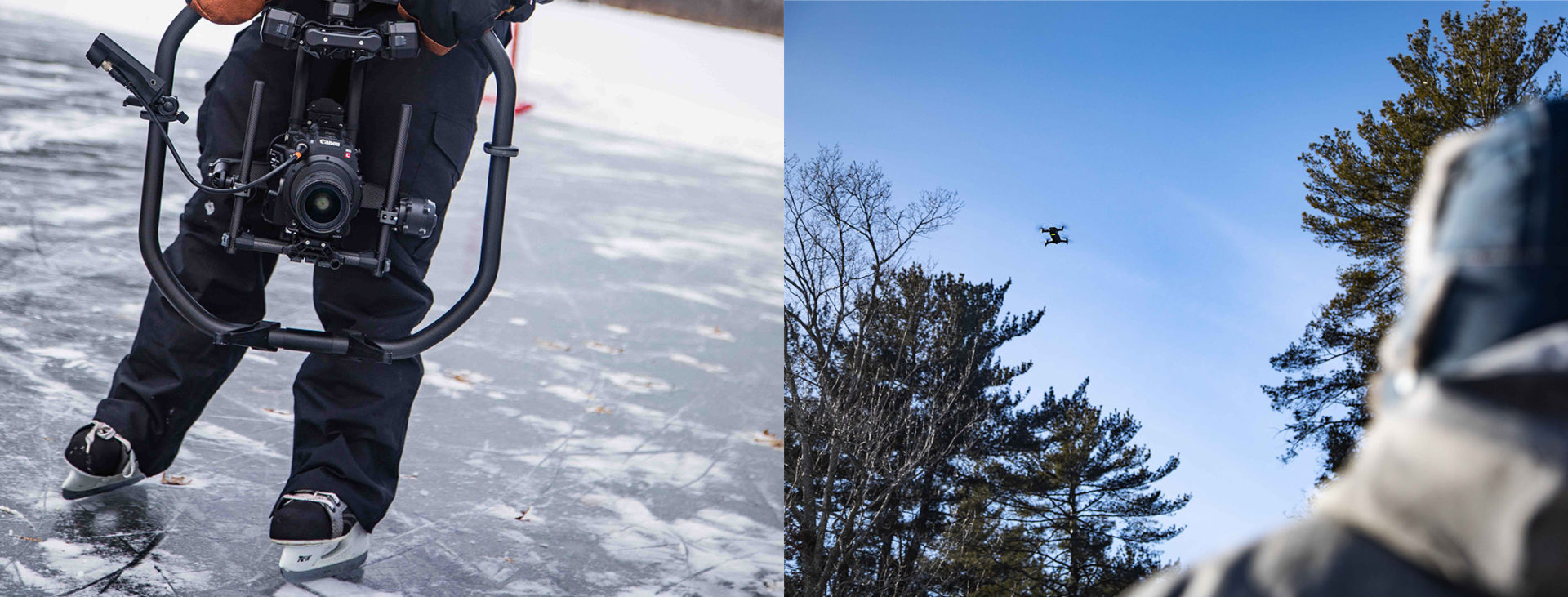
    Let me preface this write-up by stating that I am still a newcomer to the drone videography world. My goal for a while has been to learn any video rig I can get my hands on, and this is the most logical next step. The value in drone videography is obvious as well; shots from the sky add an interesting perspective to your video that simply cannot be replicated.

    At first I was under the impression that someone can go out and buy one of these and use it freely, similar to a remote controlled car- boy was I wrong. Here are a few tips and other things you should consider when becoming a drone enthusiast

    1. Start Small: A drone big enough for a camera complete with all the necessary batteries, prop guards, gimbal, and controllers will set you back at least a couple thousand dollars. Before making such a purchase, I found that buying this $70 drone is a great stepping-stone before graduating to the bigger contraptions. It helps with getting a feel for the controls, air resistance, and aerial maneuvering. It’s also inevitable that you’re going to have a few crash landings, which won’t damage it because of the small size (the drone in the link fits in the palm of your hand).
    1. Take a Class: Flying a drone is not a “plug and play” solution. There are important details such as calibration, course setting, home lock, airport communications, and many other things you need to know that can’t be summed up in a brief YouTube video. I found that taking an in-person course really helped me get familiar with both the drone and the app. The instructors are all licensed helicopter pilots who can address any other questions you may have, and there’s a block of class time that’s used for flight practice.
    1. Stay Current with Government Regulations: The FAA controls all of the airspace in our atmosphere. Whether it’s a few inches above your head or 400 feet off the ground, they are the ones who make the rules. It’s important to read up on their current and proposed regulations, so that you don’t get ticketed or fined for flying illegally. Right now, in order to make money from flying you’ll need to obtain an FAA 333 Exemption, or be a commercial airline pilot. While this paperwork can be easily applied for, it takes roughly six months for it to get approved and sent back. I’m writing this blog in June, and it’s been rumored that the FAA will be coming out with a separate set of drone pilot regulations this month. We’re still waiting on that, which leaves a lot of us commercial drone pilot hopefuls in limbo.
    1. Practice, Practice, Practice: Similar to the first tip I covered earlier in this blog, you can never have enough practice. After all, a great aerial shot cannot be achieved without great aerial maneuvering. Setup a chair or trash barrel in your yard and practice orbiting around it, with the nose of the drone constantly facing the subject. Once you’ve mastered that, give these a try.

    To sum it all up, it seems like drone flying is a hobby/professional tool that is here to stay. It’s an activity that should be done with safety as the number one concern, and enthusiasts should not rush to the finish line. I’ll leave you with my three favorite drone videos on YouTube (1) (2) (3). Happy flying!

    Fill out the form below to schedule a free strategy call with our team.


  • Why our acquisition of video agency Skyscope makes sense

    Earlier this week, we shared news about Matter acquiring Skyscope, an established video services agency with offices in Cambridge and Worcester, Massachusetts, and I’m elaborating on this event and sharing a few reasons why this deal makes good sense – for our agency, our clients and for the dynamite gang at Skyscope:

    First, every smart and savvy marketing organization should deliver compelling visual content to the key audiences of their PR and social media initiatives, and the demand for this content will only increase in the future. My immediate point: we’re strengthening the already-strong suite of services offered by Studio-C, our in-house creative team. The combined Skyscope and Studio-C entity raises our creative profile and allows us to compete with larger, more established creative players who don’t have the flexibility to deliver sought-after projects at our budget level or operational efficiency.

    Second, the fit – including the chemistry between staff, the complementary services, etc. – is dynamite. I sat with a number of other great creative shops, but our philosophies weren’t nearly as aligned as they are with the Skyscope crew. They prioritize the quality of their deliverables in the spirit of working with a client on a repeat basis, and they shoulder the burden of getting the task done right. In addition, our organizations share a professional work ethic of rolling up our sleeves and getting things done, while also being certain we have ample opportunity to blow off steam and have fun.

    Third, the Skyscope staff is A+. Their professionalism is evident in the work they deliver to their high-profile technology and business-to-business clients on a daily basis, but you further realize the value of the organization when you get to know them personally. It’s extraordinarily exciting to welcome a team of top-notch people who happen to be great at what they do, which mirrors the description of the staff already on the team here at Matter.

    Fourth, the combined experience of our creative teams is on par with any creative agency, anywhere. You have a solid foundation on which you can build when you’ve worked on behalf of consumer and technology brands such as LoJack, Pinterest, CVS Health, FootJoy, Cuisanart, CloudLock and Dassault Systemes, to name only a few. Being able to leverage the experiences and success will go a long way for entities looking to get into video-supported marketing with gusto.

    And, finally, by acquiring Skyscope, our agency is addressing a number of key interests that we prioritized as part of a strategy to help our agency grow. This includes but isn’t limited to growing our in-house creative team, and expanding to the point where we will have creative representation in all of our offices nationwide. And, most importantly, acquiring Skyscope enables us to grow in a way that allows our staff to embrace new creative technologies that will be sought-after by clients in the years ahead, and letting all of our professionals continue to spread their professional wings.

    Watch this space. It’s going to be an exciting year.